




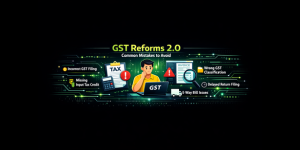
Avoid costly GST errors with GST Reforms 2.0 common mistakes to avoid. Ensure compliance, accuracy, and smooth business operations.

Wrong Filing

Input Credit Errors

Data Mismatch
Introduction
The transition to GST 2.0 introduces a more advanced, technology-driven tax system that demands higher accuracy, real-time reporting, and strict compliance. Understanding GST Reforms 2.0 common mistakes to avoid is essential for businesses aiming to stay compliant and avoid penalties, financial losses, and operational disruptions.
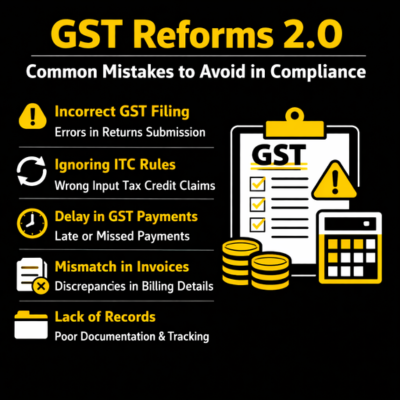
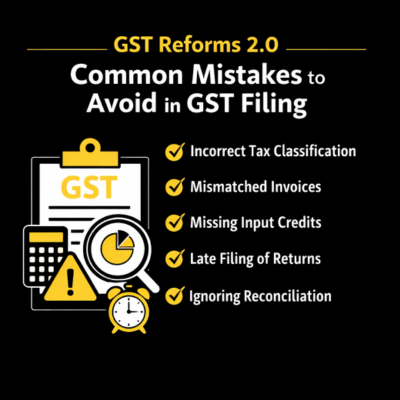
With automation, AI-based validations, and tighter integration between systems like e-invoicing, e-way bills, and GST returns, even small errors can trigger compliance issues. Common mistakes such as incorrect tax classifications, mismatched input tax credit (ITC), delayed filings, and inaccurate reporting can lead to serious consequences under GST 2.0.
Businesses must adopt a proactive approach by identifying potential risks, improving processes, and leveraging technology to minimize errors. Whether you are a startup, SME, or enterprise, avoiding these common mistakes ensures smoother operations, better financial control, and stronger compliance.
Our expert solutions help businesses identify, prevent, and resolve GST errors while ensuring seamless alignment with GST Reforms 2.0 requirements.
GST 2.0 significantly increases the importance of accuracy and compliance in tax management. One of the primary reasons this service is critical is error prevention. Many businesses unknowingly make mistakes in tax filing, invoicing, and reporting, which can lead to serious financial implications.
Key Features of GST Reforms 2.0 Common Mistakes to Avoid Solutions
Our solutions include advanced features to minimize errors:
Enterprise-Grade Security by Design
Your data, models, and workflows are protected by modern security standards. Block-AI is built with privacy, compliance, and reliability at its core.
- End-to-end data encryption
- Compliance-ready architecture
Another important factor is real-time validation. GST systems now detect mismatches instantly, leaving little room for correction after submission. This makes it essential to get everything right the first time.
Additionally, avoiding mistakes improves operational efficiency. Businesses can reduce manual corrections, save time, and focus on growth rather than compliance issues.
Lastly, it enhances credibility. Consistent compliance builds trust with authorities and stakeholders.
By addressing GST Reforms 2.0 common mistakes proactively, businesses can operate with confidence and stability.
Types of GST Reforms 2.0 Common Mistakes to Avoid Solutions
We offer tailored solutions to help businesses identify and eliminate common GST errors:
- GST Error Audit & Diagnosis
Identify common mistakes in filings, invoicing, and reporting. - ITC Reconciliation & Validation Solutions
Ensure accurate input tax credit claims and prevent mismatches. - GST Filing Accuracy Services
Improve accuracy in return filing and tax calculations. - HSN/SAC Code Validation Solutions
Avoid incorrect tax classification errors. - Automated Compliance Monitoring
Detect and prevent errors in real time. - GST Training & Awareness Programs
Educate teams on common mistakes and best practices. - Custom Compliance Solutions
Tailored strategies based on business needs and industry.
Identifying and avoiding common mistakes under GST Reforms 2.0 offers significant advantages for businesses aiming to maintain smooth and compliant operations. With evolving rules, digital reporting systems, and stricter validations, even minor errors can lead to penalties, delays, or compliance notices. By being aware of frequent pitfalls—such as incorrect filings, mismatched invoices, or missed deadlines—businesses can proactively improve their processes, reduce risks, and ensure accuracy in tax reporting. This awareness not only minimizes financial and legal consequences but also enhances operational efficiency, builds credibility, and supports long-term business stability in an increasingly regulated tax environment.
Fewer Filing Errors
Avoids common mistakes that lead to return rejections.
Reduced Penalties
Prevents fines by ensuring accurate and timely compliance.
Better Data Accuracy
Improves invoice matching and reporting precision.
Faster Processing
Ensures smooth return filing and quicker approvals.
Strong Compliance Record
Maintains a clean track record with tax authorities.
Business Efficiency
Streamlines processes by eliminating repeated errors.
GST Reforms 2.0 Common Mistakes to Avoid Development Process
We follow a structured approach to eliminate GST errors:
- Initial Assessment & Error Analysis
Identify existing mistakes and compliance gaps. - Risk Identification & Prioritization
Analyze high-risk areas affecting compliance. - Strategy Development
Create a customized plan to eliminate errors. - System Integration & Automation
Implement tools for error detection and prevention. - Data Validation & Correction
Ensure accuracy in financial and tax data. - Testing & Compliance Verification
Validate system performance and compliance readiness. - Training & Implementation
Train teams on avoiding common GST mistakes. - Ongoing Monitoring & Support
Provide continuous error tracking and improvements.
Technology Stack
We use advanced technologies to deliver reliable solutions:
- Frontend: React.js, Angular, Vue.js
- Backend: Node.js, Python, Java
- Databases: PostgreSQL, MySQL, MongoDB
- Integration: GST APIs, REST APIs
- Cloud Platforms: AWS, Microsoft Azure, Google Cloud
- Analytics Tools: Power BI, Tableau
- Security: SSL encryption, OAuth, role-based access control
This ensures secure, scalable, and high-performance solutions.
Cost Factors of GST Reforms 2.0 Common Mistakes to Avoid Services
The cost of implementing GST error prevention solutions depends on:
- Business size and transaction volume
- Complexity of GST processes
- Number of errors and correction requirements
- Level of automation needed
- ERP and system integration requirements
- Customization and reporting features
- Data reconciliation complexity
- Ongoing support and monitoring
Latest Trends in GST Reforms 2.0 Common Mistakes to Avoid
The GST compliance landscape is evolving rapidly:
- AI-driven error detection and validation
- Real-time GST data synchronization
- Automated reconciliation and ITC matching
- Integration with e-invoicing and e-way bill systems
- Cloud-based compliance platforms
- Predictive analytics for risk identification
- Mobile dashboards for real-time monitoring
- Increased focus on data accuracy and automation
These trends highlight the importance of avoiding errors proactively.
Why Choose Us for GST Reforms 2.0 Common Mistakes to Avoid Services
Choosing the right partner ensures accurate and compliant GST operations:
- Expert GST Knowledge – Deep understanding of GST 2.0 requirements
- Error Prevention Focus – Identify and eliminate common mistakes
- Customized Solutions – Tailored to your business processes
- Advanced Automation Tools – Reduce manual errors
- Seamless Integration – Connect with ERP and accounting systems
- Scalable Solutions – Grow with your business
- High Data Security – Protect financial information
- Dedicated Support Team – Continuous assistance and monitoring
We help businesses achieve error-free GST compliance.
Struggling with GST errors under GST Reforms 2.0?
Let us help you eliminate mistakes and stay compliant.
Contact us today for expert GST compliance solutions.
FAQ
Common mistakes include incorrect tax rates, mismatched ITC claims, late filing, and inaccurate reporting.
By using automated tools, validating data, training teams, and ensuring accurate filings.
Uncorrected errors can lead to penalties, ITC loss, and compliance notices.
Yes, businesses of all sizes can make mistakes and must ensure compliance.
Some errors can be corrected, but real-time systems make prevention more important.
Automation reduces manual errors and ensures accurate, real-time compliance.